
⚙️ Kill Mouse Fatigue

Good Morning, The Hardwirers!
Today’s lineup feels like a tour through the next phase of human-machine intimacy: If these devices are a preview, the next wave of hardware won’t just assist us; it will observe us, predict us, and reshape the micro-routines we never thought to question. Buckle up.
KEYBOARD
The Keyboard That Kills Mouse Fatigue
👀 What is it: The ZSA Voyager is a compact, split mechanical keyboard designed for people who live on their computers. It builds on the company’s ergonomic pedigree with the Navigator, a detachable trackball module that magnetically attaches to either side. The idea isn’t to ditch the mouse entirely, but to pull cursor control back within the reach of your thumbs, letting you scroll, click, and type without constant lateral hand travel.
🧪 Reality Check: ZSA’s engineering here is thoughtful rather than flashy. By integrating a trackball into the keyboard’s frame, it eliminates the stop-start rhythm of moving between mouse and keys, cutting down wrist strain and micro-interruptions that kill flow. The split layout and low-profile switches make it surprisingly portable, and 3D-printable shells allow users to fine-tune the module’s position, a small but rare nod to true ergonomics.
⚙️ Our take: Not a mouse killer, but a muscle saver. Voyager turns the desk into one continuous input surface, and that makes more difference than you’d think.
EEG
EEG Meets Everyday Stress
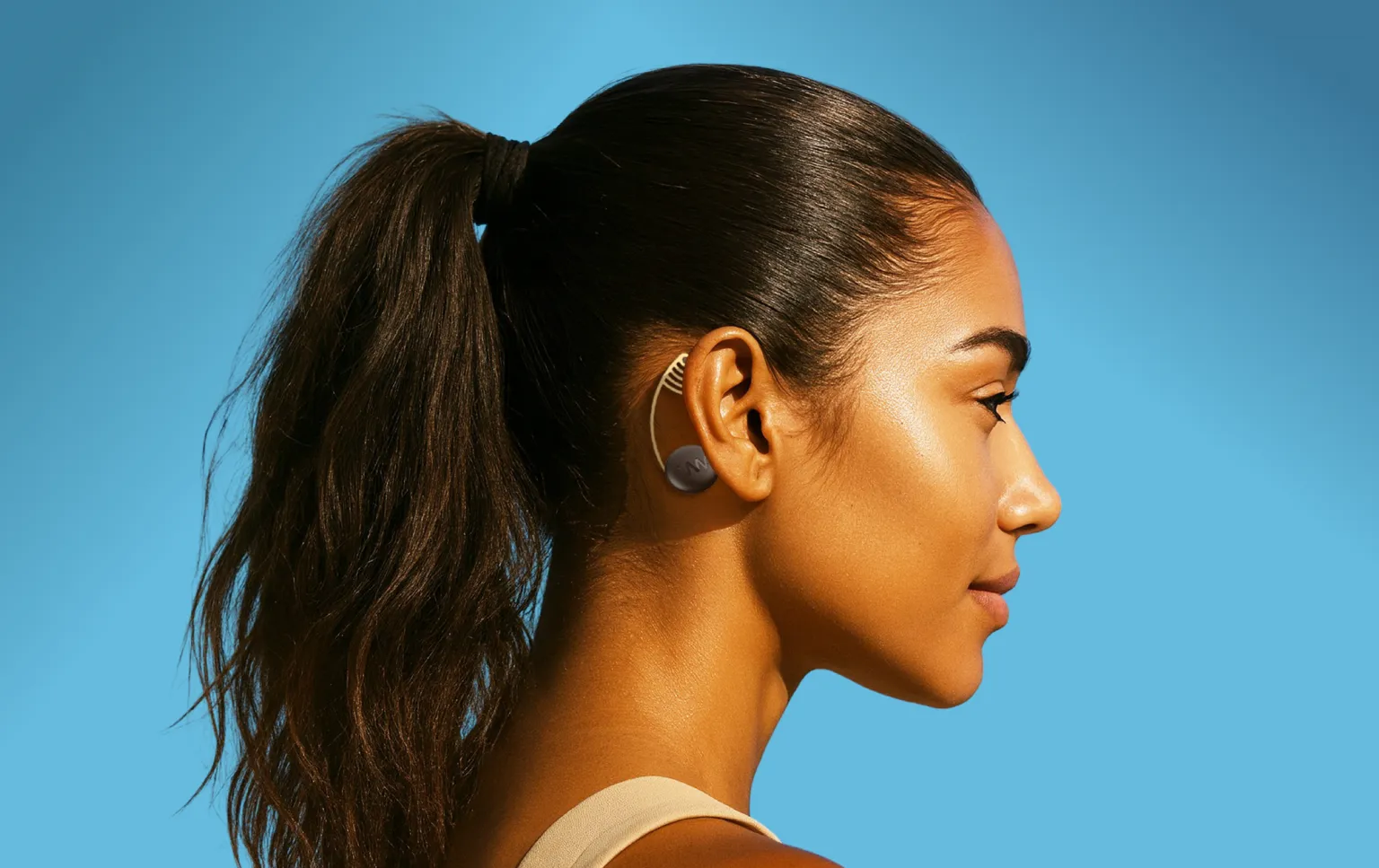
👀 What is it: Awear is a behind-the-ear wearable that bills itself as a “Fitbit for your brain.” It continuously monitors EEG signals to track beta-wave activity—those high-frequency oscillations that spike under stress—and pairs the data with an AI-driven app offering real-time mood insights and coping prompts. Instead of counting steps, it quantifies tension, aiming to catch chronic stress before it compounds into anxiety or burnout.
🧪 Reality Check: Unlike mindfulness gadgets that rely on heart rate or skin conductivity, Awear goes straight to the source—electrical brain activity. That’s an engineering leap that trades simplicity for precision. The design borrows clinical-grade EEG logic and compresses it into a discreet, consumer-grade form factor with continuous data capture and no electrodes glued to your scalp. For knowledge workers and founders who run on adrenaline, this could finally make stress measurable in the same way calorie burn is.
⚙️ Our take: Awear turns stress tracking from guesswork into signal processing. If its sensors prove reliable outside the lab, this could become a mental-health wearable that finally measures, not guesses.
WEARABLE
Friend AI: The Always-On Companion That Won’t Shut Up
👀 What is it: The Friend AI Necklace is a wearable “companion” that promises to always be there for you, and it means that literally. Worn like a pendant, it houses always-on microphones that stream audio through your phone to the cloud, where Google’s Gemini 2.5 does the heavy cognitive lifting. The paired Friend app then sends you texts: observations, advice, or snarky remarks about whatever it thinks you’re doing. It’s marketed as a pocket therapist meets chatty best friend, though most testers say it behaves more like a judgmental roommate that never stops typing.
🧪 Reality Check: Technically, this architecture isn’t new. Countless wearables already do the record-upload-reply loop. What Friend adds is the illusion of real-time emotional presence: no wake word, no prompt, just an AI shadow that reacts to you as life happens. The design is clever in latency control and battery trade-offs, but socially fragile. The same constant awareness that makes it feel alive also makes it invasive, especially when it chirps mid-conversation. It's one true innovation—ambient companionship—also happens to be its biggest liability.
⚙️ Our Take: Friend shows how wearable AI could work; but also why most people still prefer their friends without firmware.
TOGETHER WITH US
AI Secret Media Group is the world’s #1 AI & Tech Newsletter Group, boasting over 2 million readers from leading companies such as OpenAI, Google, Meta, and Microsoft. Our Newsletter Brands:
- AI: AI Secret
- Tech & Business: Bay Area Letters
- Marketing: Marketing Secret
- Robotics: Robotics Herald
- Hardware: The Hardwire
We've helped promote over 500 Tech Brands. Will yours be the next?
Email our co-founder Mark directly at mark@aisecret.us if the button fails.